AI Assurance / Backup
For institutions with an internal specialist who can assess material events and provide an independent human conclusion.
$40K ARR
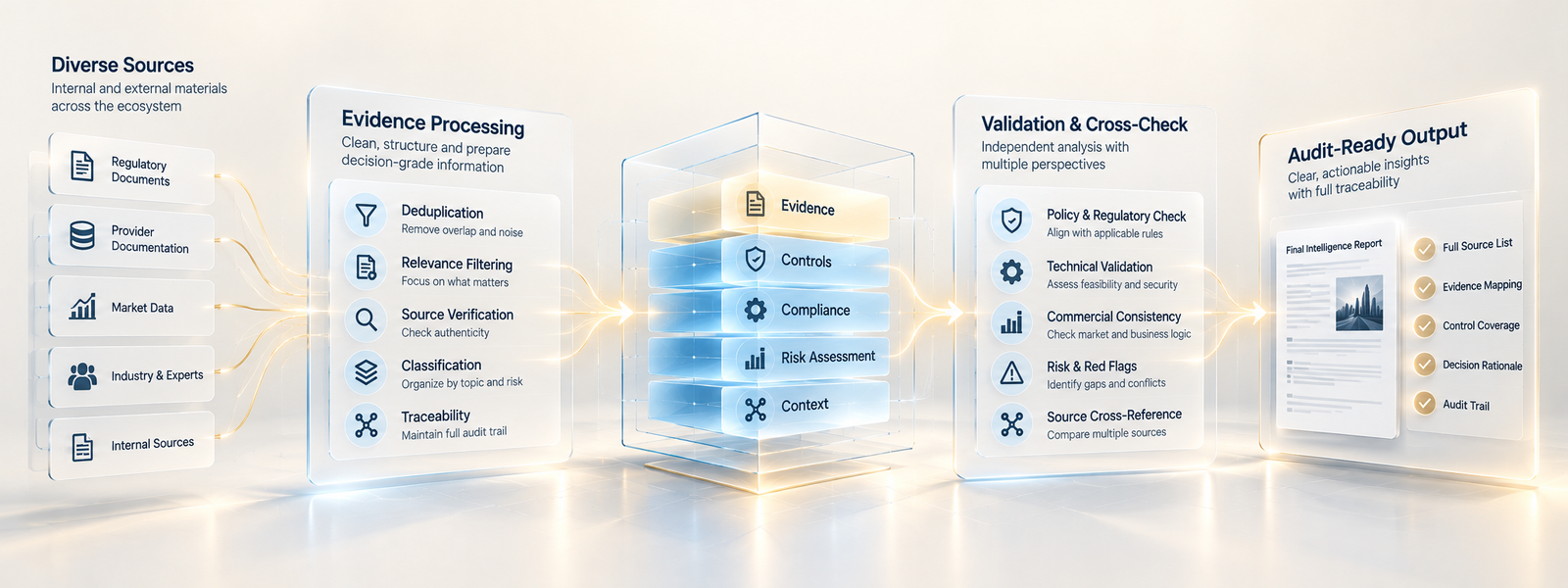
Edrival identifies material developments affecting digital-asset operations, preserves supporting evidence, and reconciles independent human and AI assessments into a reviewable intelligence briefing.
Two AI models detect and validate material events. A third assesses the evidence independently of the human reviewer; a fourth reconciles both conclusions against the evidence. Unresolved differences remain visible, and the institution retains the final decision.
A single material event can affect regulation, liquidity, custody, counterparties and operational dependencies at the same time. Evidence arrives from different sources, at different speeds and with different levels of authority.
Where judgement can fail
Regulatory, market, technical and provider changes do not arrive in one system or one sequence.
A regulatory notice, primary data and a vendor claim require different treatment.
A human analyst or an AI model can misclassify an event, overlook a dependency or give one source too much weight.
The institution should be able to show what was known, how it was assessed and why the final view was reached.
The assurance gap
The need is not another feed. It is a controlled process that validates the event, builds a common evidence record, keeps human and AI assessments separate until reconciliation and records how the final conclusion was reached.
Three layers. Four AI roles. Human accountability.
Institutional context
Approved sources, exposures and policies give every assessment the same institutional context. Each event keeps its own versioned reference point.
One context. A consistent starting point.
Human assessment
AI Assurance · Your institution supplies the human assessment.
Institutions with qualified internal analysts can retain that function. Others can use a managed specialist. Both services follow the same evidence and review process.
The institution retains responsibility for its final decisions in either mode.
Included in both modes
The annual subscription depends on who performs the human assessment. The four AI model process is included in both.
For institutions with an internal specialist who can assess material events and provide an independent human conclusion.
$40K ARR
For institutions that require specialist human review as part of the service rather than assigning that work to an internal analyst.
$99K ARR
Scope and pricing
AI Model 4 reconciliation is included in both subscriptions. Customer data licences or premium data access may be scoped separately. Figures are planning prices, subject to customer requirements and agreement.
Monitoring starts with the institution’s assets, operating arrangements and obligations. The relevant sources and event rules depend on those exposures.
The categories remain consistent. The monitored dependencies, triggers and available evidence are configured for each client.
Assets · Networks · Issuers · Providers · Jurisdictions · Obligations
Issuance, reserves, redemption and payment instruments
Rights, servicing, restrictions and valuation
Networks, liquidity, venues and protocols
Asset control, movement, cash and collateral
Licences, restrictions and legal obligations
Banking, operational and strategic dependencies
The V1 design defines nine event families. Events enter review when the evidence, client exposure or mandatory retention rules require it.
Reserve changes, depegs, issuance or redemption restrictions.
Price dislocations, depth deterioration and spread changes.
Security incidents, service outages and transfer suspensions.
Chain interruptions, bridge incidents and material upgrades.
Insolvency, access restrictions and service termination.
Banking access, payment rail outages and settlement failures.
Enforcement, licence decisions and new operating obligations.
Asset servicing, valuation, registrar and transfer restrictions.
Material partner, ownership or service scope changes.
Each case retains the source material, the applicable institutional context and the evidence used in assessment.
One event record, with distinct sources.
Origin, retrieval time and source history.
Relevant assets, providers and jurisdictions.
The evidence and profile used at assessment.
The case records the evidence, separate assessments, reconciliation and resulting institutional action.
The institution retains final decision authority. Unresolved differences remain visible rather than being treated as agreement.
Canonical evidence, source time and institutional profile version.
Reviewer conclusion, rationale and submission record.
Independent conclusion, held from the human assessor until submission.
Both assessments checked against the original evidence, with differences retained.
Reported conclusion, follow up and the institution's recorded decision.
Sources are screened against each institution’s versioned asset, issuer, custody, liquidity, network and jurisdiction profile. Retained cases keep their evidence.
Event Queue
Retained events in reviewCase workspace
Follow a retained event through its evidence record, two independent assessments and final briefing.
Case 001 / Digital Money
Redemption access suspended
Layer 1 / Retained events
AI Model 1 detects and filters. AI Model 2 independently detects and validates against the same sources and context version.
Layer 1 / Case 001
One event record retains its rule, institutional context and source history.
AI Model 1 and AI Model 2 submit independent candidates. Matching events merge; sources and disputed signals remain linked.
Layer 1 / Case 001
One event retains corroborating sources, both model traces and the institution’s context version.
Source records, model findings and unresolved differences stay with one canonical event.
Layer 2 / Separate assessments
Both assess the same evidence. Model 3 stays hidden until the human submission is locked.
A client analyst or managed specialist assesses the evidence and the institution’s exposures.
Makes an independent assessment without access to the human conclusion.
Layer 3 / AI Model 4
Model 4 tests both locked assessments against the original evidence.
Records evidence support, agreements and unresolved differences. No forced consensus.
Case 001 / Output
The final briefing records supported conclusions and what remains uncertain.
Check affected assets, liquidity arrangements and obligations before deciding how to respond.
Sources and institutional context version
Locked Human and AI Model 3 records
Model 4 evidence checks and open issues
What the institution receives
The record preserves source evidence, the context version, both independent assessments and the reconciliation result.
A reported redemption restriction may affect liquidity and operations. Confirm the institution’s exposure and obligations before determining a response.
Institutional access, evidence handling and model execution require defined boundaries. Edrival is designed to preserve those boundaries as each event is assessed.
Every case should carry a reviewable record of who accessed it, which evidence was used and how the assessments were produced.
Defined roles, permissions and responsibilities.
Encrypted material, managed keys and case history.
Separate human review, AI assessment and reconciliation.
Security & institutional readiness
The planned security model covers access, encryption, separation of duties, source continuity and the evidence required to review each case.
Roles limit who may see, operate or change sensitive functions.
Managed encryption and key controls protect evidence and configuration.
Unavailable feeds, delayed updates and degraded coverage remain visible.
Source material, changes, timestamps and profile versions remain traceable.
AI Models 1 and 2, human review, Model 3 and Model 4 have distinct roles.
Assessment order, model versions, reconciliation and authorised decisions can be reviewed.
These controls describe the intended architecture. Deployment, effectiveness testing and independent security review remain subject to funded implementation and validation. No security certification is claimed.
The first buyer already operates live digital money flows. Its assets, counterparties, technology and obligations determine which external changes Edrival must examine.
Stablecoin payment providers and cross border fintechs in production. Monitoring scope is configured separately for each institution.
Events are selected against the client profile, agreed monitoring scope and available sources.
Priority follows production exposure, operating responsibility and the need for specialist review. The customer groups are not equally immediate.
Stablecoin enabled PSPs, cross border fintechs and treasury payment infrastructure with live issuer, network, custody and liquidity dependencies.
Digital asset custodians, tokenization and RWA platforms, and specialist institutional infrastructure operators.
Crypto funds with material operational exposures, followed by banks and other institutions as use cases and buying demand are validated.
Primary outreach targets live digital-money payment operators; adjacent and expansion segments remain eligible when their needs qualify.Buyer research & methodology ↗
Data and monitoring systems provide essential intelligence. Edrival is designed to bring material developments into a governed assurance process, grounded in the institution’s operating context.
Commercial approachWorks alongside existing providers and internal teams. Initial engagement is planned through named-account discussions and scoped design partner pilots, subject to validation.
Blockchain intelligence, market information, regulatory updates and internal records.
Independent human and AI assessment, reconciled against a traceable evidence record.
Accountable review, escalation and action remain with the institution.
The base case models 2 active institutions in Year 1 and 337 in Year 10. Revenue follows the planned mix of AI Assurance and Managed Intelligence contracts.
Illustrative financial modelYear end ARR is contractual run rate, not revenue recognised during the year.
The planning universe expands as qualified institutional buyers enter the addressable operating scope. The figures represent selected serviceable accounts, not a published market size estimate.
Operating break even
planning target
The serviceable-universe counts are internal planning assumptions, not verified market totals. Y3 break-even remains a conditional target. 10-year research & methodology ↗
Founder, Edrival
Institutional Digital Assets & Market Infrastructure
Orcun Onur brings more than 20 years of experience across marketing, growth and international market development, including more than eight years focused on institutional digital assets and market infrastructure.
His work spans BtcTurk PRO, the Stablex market launch and institutional advisory through CryptoWisely, covering go-to-market strategy, tokenization, operating models and market expansion.
He is writing Institutional Digital Assets: Operating Models, Controls, and Market Structure , forthcoming from Apress / Springer Nature.
A fuller account of operating experience, advisory work and research. Selected engagements remain confidential under client agreements.
More than 20 years across marketing leadership, commercial strategy, growth, customer acquisition and international market development. Recent work is concentrated in digital assets and the infrastructure required for institutional adoption.
Worked on brand and growth during the period when the platform expanded from approximately 900,000 to more than five million users. This is a contribution during a company-wide growth period, not a claim of individual attribution. Recipient of the 2021 Insider LIFT Award.
Led the market launch and worked with banking, legal, compliance, product and executive teams. The role included institutional market development and involvement in the acquisition process that brought the business into the Ak Yatırım and Akbank ecosystem.
Co-founder of CryptoWisely, working on institutional digital-asset advisory, go-to-market planning, market infrastructure, tokenization, vendor and product positioning, and expansion decisions. Confidential client work is not disclosed without permission.
Author of the forthcoming Apress / Springer Nature book Institutional Digital Assets: Operating Models, Controls, and Market Structure , examining operating models, controls, settlement, treasury and institutional market structure.
Institutional decisions that sit between product strategy, market infrastructure and execution: understanding counterparties and operating dependencies, assessing market entry, and building evidence-based commercial and advisory approaches.
Edrival is preparing a focused pre-seed validation round to build the pilot-ready product, complete the required technical and security validation, establish early institutional customer evidence and test the recurring commercial model.
Capital allocation
Most of the round funds the product and validation programme. Market-entry spending follows product-readiness gates.
$525K
Product build, data and model infrastructure, technical delivery, security validation, operating capacity and the work required to reach a credible institutional pilot.
$150K
Named-account development, partner and referral activity, relevant institutional events, customer acquisition and commercial validation after readiness gates are met.
Build the bounded assurance workflow and operating environment.
Test model behaviour, evidence controls and institutional readiness.
Intensify qualified pilot and annual-contract conversations after product readiness.
Use measured demand, conversion evidence and operating performance to determine the next financing step.
Investor case
The round is designed to prove a repeatable institutional business. Not only a working prototype.
Demonstrate that the assurance workflow can operate reliably with controlled evidence, independent assessments and reconciliation.
Validate that qualified institutions recognise the problem and will engage with a structured assurance workflow around material decisions.
Test whether the two operating modes can convert into recurring annual subscriptions rather than remaining project-based advisory work.
Show that software, methodology and managed human review can scale without building a large specialist organisation before demand requires it.
Investor materials
Explore the narrated investor presentation covering the product, commercial model, validation programme and financing case. Buyer Segmentation · PDF ↗ 10-Year Market Methodology · PDF ↗
Edrival is in development. We welcome discussions about institutional use cases, product validation, investment and strategic partnerships.
Institutional teams
Tell us which infrastructure, provider or material event your institution needs to assess.
Investors & strategic partners
Review the operating thesis, validation plan, commercial assumptions and financing proposal.
Edrival currently uses technologies required for site operation, security and remembering your privacy choices. Optional analytics or marketing technologies, if introduced, remain disabled unless you allow them.
Choose which optional technologies Edrival may use. Essential technologies cannot be disabled because they are required for core site operation, security and for remembering your privacy preferences.
Required for basic site operation, security and remembering privacy preferences.
Reserved for optional aggregate usage, performance and site experience measurement if introduced later.
Reserved for optional campaign, attribution or external platform measurement if introduced later.